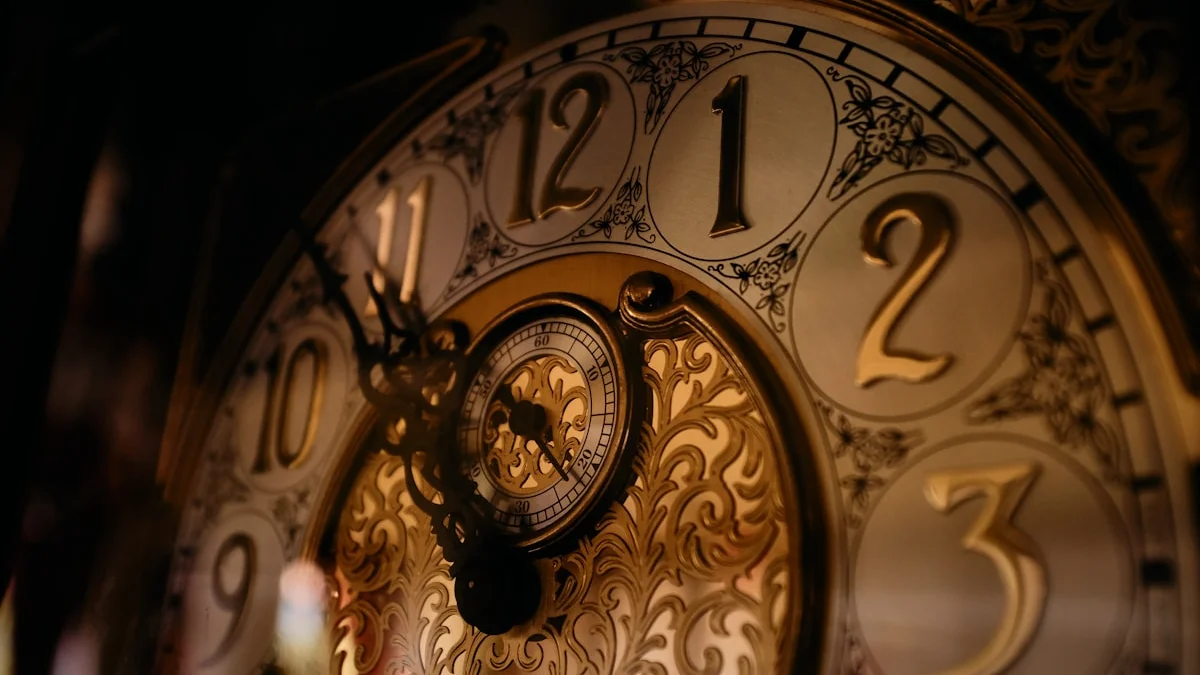
It is 5:50 in the morning and the house is not yours yet. The kettle has not spoken, the phone has lied to no one, and the day has not arrived with its demands. For the next forty minutes the current that will soon carry everyone else is still near the bank, and a chair behind a closed door is the cheapest place in the world to stand outside it. This is why the doctrine cares less about how long you practice than about when. A fixed hour practice turns the ritual from an event into an address — a coordinate the Field learns to expect — and the compound follows the address, not the effort. The protocol this hour anchors is laid out in the daily ritual guide.
Key takeaways
- The Field compounds what repeats at the same address; the hour is the address.
- Seven days kept at a fixed hour outweigh thirty days kept at whenever.
- Repetition, not intensity, is the first term of the arithmetic.
- Choose an hour you can defend on your worst day, not your best one.
- A missed hour is resumed, never restarted; the chain lives in the log.
What a fixed hour practice actually is
The fixed hour is not a superstition about clocks, and it is not punctuality wearing mystical robes. It is a craft constraint, the way a workshop keeps its benches where the hands expect them. When the practice runs at the same hour in the same seat, the deep mind stops spending attention on orientation — where am I, what is this, what happens now — and starts spending it on the work. The book calls the chair an address the Signal recognizes, and the hour is part of the address. Change the hour every day and you have moved the workshop nightly; the instrument never quite arrives, and every session begins with setup instead of craft.
The Field compounds what repeats at the same address
The doctrine’s own case for the hour is one sentence deep.
“The Field compounds what repeats at the same address. Seven days at 6:00 outweigh thirty days at “sometime.””
Notice what the comparison says. Thirty is larger than seven, and the fixed seven still win, because the compound is not counting sessions — it is counting returns to the same place. Sometime is not a small address; it is no address at all. Each repetition at a consistent hour is a deposit into an account the Field keeps by location, and each variation is a deposit into a different account, which is to say a withdrawal dressed as flexibility. This is why the practice feels different after a week of sameness than after a scattered month of more total minutes: the signal has been arriving somewhere, rather than everywhere.
Repetition outranks intensity
The hour matters because the doctrine’s arithmetic is built on frequency first.
“A mediocre sequence performed daily defeats a brilliant sequence performed occasionally, every time, in every life the Folios ever recorded.”
That is a strong claim, and its edge is the word occasionally. A brilliant hour kept whenever inspiration supplies one is a performance, not a practice. The compound curve does not care about your enthusiasm; it cares about the pattern’s recurrence. Practitioners who understand this stop negotiating for extraordinary sessions and start protecting ordinary ones — the unremarkable twenty-five minutes at the defended hour, repeated until the repetition itself is the teacher. The dramatic morning that happens twice a week teaches the Signal that drama is the price of practice, which is exactly the lesson the Key refuses to teach.
Choosing an hour you can defend
The doctrine’s bias is toward the early morning, and the reason is hydraulic. A day is a current; by afternoon you are inside it, being carried. In the first hour after waking, the current has not yet taken your weight, and the same descent costs a fraction of what it costs at midnight, when the sale is in session and the auctioneer is shouting. Train the instrument early and the training holds through the noise.
The practical test is not which hour is ideal. It is which hour survives your worst Tuesday. An ambitious 5:00 slot that collapses the first time the night runs short is a weaker address than a modest 6:30 you have actually kept. Choose the hour that exists even when the day misbehaves, and let the chair — never the bed — be waiting there. The Key itself says it plainly: “The Key is not kept by feeling like it. It is kept by being in the chair.” Feeling arranges nothing; the address arranges everything.
When the hour has to move
Life inspects this rule eventually: travel, illness, children, a shift pattern that will not sit still. The doctrine handles this with the same severity-free logic it applies to missed days. When the hour cannot be kept, the practice is not abandoned and not theatrically restarted — it is resumed at the next possible sitting, and the log records the truth.
“Resume, never restart. A man who misses Tuesday and resumes Wednesday is on his eighth day. A man who misses Tuesday and restarts is on his first day forever.”
For rotating schedules the address moves with the pattern: a fixed hour relative to the shift — always the first hour after waking, whatever the clock says — preserves the regularity the compound actually reads. The hour is a habit of return, not a devotion to a number. How the address is carried through disrupted days is worked out in the ritual hour for shift workers, and how the practice comes to pull you toward the chair rather than away from it is the subject of when the ritual stops feeling like effort. The shape of the whole practice, morning and evening, is laid out in the twenty-five and ten split and in the thirty-five minute protocol.
Frequently asked questions
Does the exact minute matter, or the general hour
The address is the pattern, not the second. A quarter hour of drift is weather; a different hour every day is a different address. Practitioners aim for a window they can hold on any day and treat the window, not the minute, as the thing the Field learns to expect.
Can I keep the fixed hour on weekends
You can, and the compound does not file weekends under exceptions. Sleeping two hours later both weekend days is, from the address standpoint, a twice-weekly relocation. If a later hour is genuinely restful and chosen, keep it deliberately and log it; the honesty matters more than the rigidity.
My schedule rotates — is a fixed hour even possible
Yes, in relative form. Fix the hour to the wake-up, not to the clock: always the first full hour after waking, in the same seat. The Field reads recurrence and regularity; a rotating absolute hour that is perfectly regular relative to the shift preserves the address better than a nominal 6:00 kept twice a week.
How long before the hour starts pulling me
Sooner than most practitioners expect, and the sign is specific: the chair acquires gravity, and the descent begins without being summoned. The hour stops being an appointment you keep and becomes a place you arrive at. That shift is measured in weeks of sameness, which is the entire argument for the sameness.
Is the fixed hour a superstition
No. Nothing about 6:00 has power over the Field; the hour is a handle for attention, the way the breath is. The doctrine is consistent on this: the objects and the times hold the practitioner while the practitioner builds the capacity. A spell would act regardless of you. An address works because you keep returning to it.
This guide is educational and spiritual in nature. It is not medical, legal, or financial advice. If a practice brings up distress, speak with a qualified professional.
The hour is the workshop, the chair is the bench, and the compound is kept at the same address or nowhere. The book that names the hour and fills it is The Obsidian Key.